"For us, preservation does not mean repetition. Tradition is a living body of knowledge that only survives if it is allowed to evolve. We respect the intelligence embedded in historical techniques, but we apply them to new forms, scales and conceptual frameworks. In this sense, innovation is not opposed to tradition, it is the condition that allows it to remain relevant."
Founded in 2013 as a father-son partnership, WonderGlass has repositioned Venetian glassmaking within contemporary art and design. Operating between London and Italy, the studio bridges historical craft with architectural ambition, working primarily on bespoke commissions that test the material's formal and conceptual limits. We spoke with them following their presentation at THEMA about tradition as evolution, the city as mental construct, and why unfamiliarity matters.
For those discovering WonderGlass for the first time, how would you introduce the company? What is its origin story, and what do you do today?
WonderGlass was founded in 2013 as a family-led initiative, born from a shared vision to rethink what a contemporary glass company could be. From the outset, the intention was not simply to produce objects, but to create a point of reference for artisan-made glass operating at the intersection of architecture, art and design.
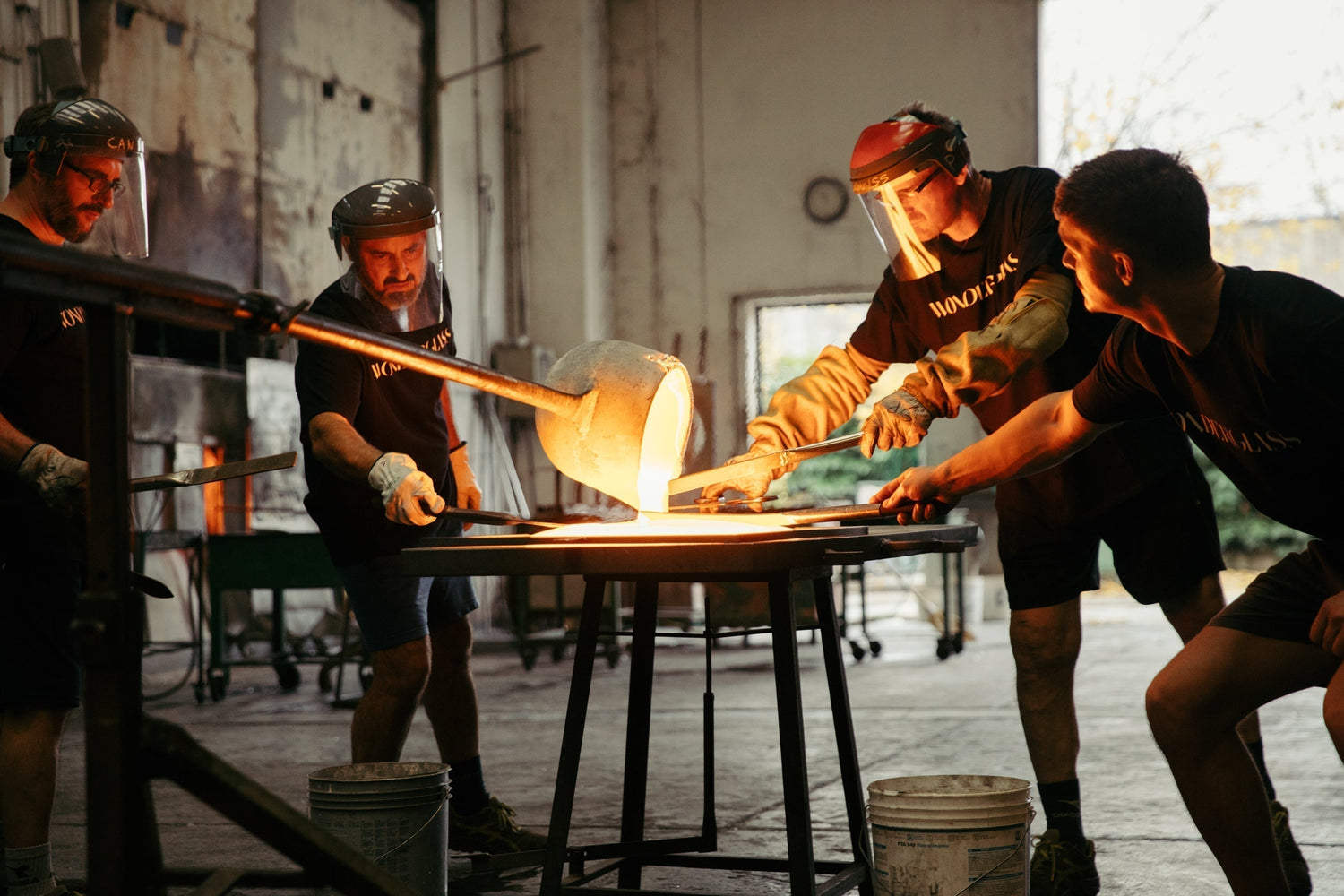
Today, WonderGlass works primarily on project- and contract-driven commissions, collaborating closely with artists, designers and architects. We support each project from concept through engineering, production and final presentation, combining a contemporary design approach with deeply rooted traditional glassmaking skills. Alongside this, we continue to develop a strong and coherent body of our own collections, which reflect our ongoing research into form, material and scale.
Why did you choose to position yourselves between London and Italy rather than consolidating in one place? What does each context bring to your practice?
Italy provides proximity to production, material knowledge and an embedded culture of making. London, on the other hand, offers a critical, international environment where design, art and architecture intersect freely. Operating between the two allows us to maintain a constant dialogue between making and thinking, between execution and discourse.
Venetian glassmaking relies heavily on long apprenticeship models. How do you ensure knowledge transfer within your workshops?
Knowledge transfer happens through close, continuous collaboration. Rather than isolating design from production, we encourage constant exchange between makers, engineers and creatives. Working alongside on complex projects, you learn not only techniques but also ways of thinking and problem-solving that cannot be taught theoretically.
Could you tell us about the work you presented at THEMA?
At THEMA, we presented a project that explored the idea of the city as a mental and imaginary construct rather than a fixed physical reality. Glass became a tool to translate fragility, density and rhythm into a spatial composition that invited viewers to move around it and project their own interpretations.

The installation sits on a mirrored table that doubles each element. What were you hoping to achieve through this reflection?
The mirrored surface introduces a sense of visual expansion and ambiguity. It destabilises the viewer’s perception of scale and quantity, while reinforcing themes of repetition, reflection and infinite extension. The work becomes less about individual objects and more about an immersive spatial experience.
What is your reading of this edition of THEMA?
This edition of THEMA felt like a refreshing pause from more established formats. There was a shared sense that many participants and visitors were genuinely open to discovering new perspectives, rather than reaffirming what they already know. In a city like Paris, where people are constantly surrounded by refined galleries, polished presentations and impeccably designed events, it felt as though there was a real appetite for surprise and for the unfamiliar.