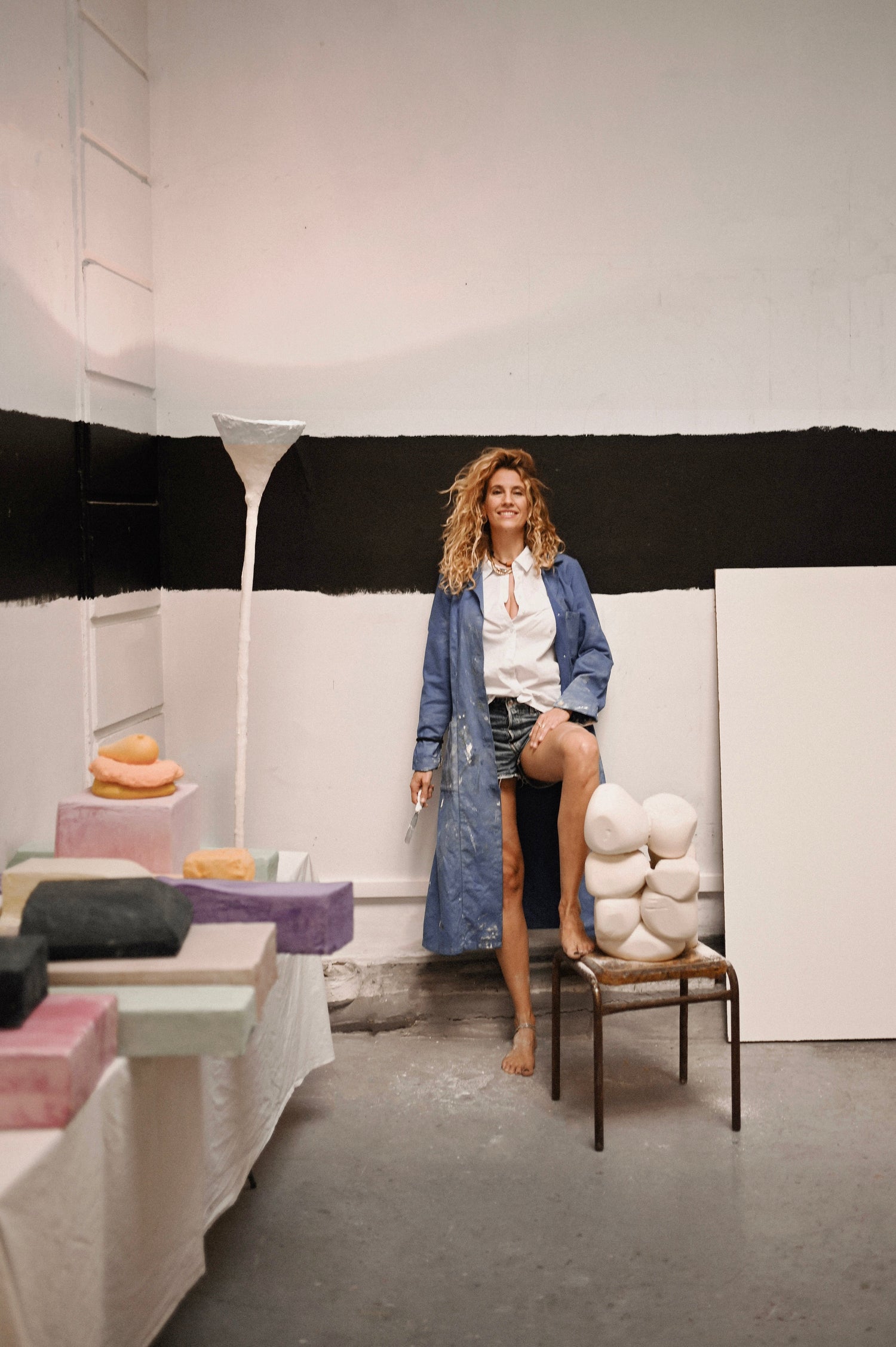
"Gypsum is central to my practice because of its plastic and technical qualities. It is malleable, recyclable, non-toxic, and works with water. It allows for precise work on surfaces and light, and its historical use dating back to Antiquity also interests me. I also value its capacity to retain the memory of gesture."
Parisian sculptor Amélie Caussade discusses her transition from physiotherapy to contemporary sculpture, revealing how her understanding of the body informs her investigation of volume through the medium of gypsum.
Can you introduce yourself and your practice for those encountering your work for the first time?
I am a visual artist and sculptor, based in Paris for about fifteen years. My practice is primarily focused on sculpture, with extensions into performance, textile, and masks. Currently, my work explores geometric abstraction, through which I investigate the relationships between form, structure, movement, and space. The human body and certain scientific concepts inform my approach, and I’m particularly drawn to the symbolic and expressive potential of masks.
You trained as a physiotherapist-osteopath before becoming a visual artist. How did that transition happen?
The transition was gradual. For many years, I practiced both fields in parallel, seeing them as separate. Over time, I realized they share a lot of common ground. My understanding of the body, developed through physiotherapy and osteopathy, directly influences how I conceive forms, volumes, and balance in my sculptures.
Does your knowledge of anatomy and the body still inform your sculptural practice today?
Yes, very much. Even though my sculptures are abstract, they are conceived as physical structures, with attention to axes, support points, tension, and proportion. This approach allows me to work with non-figurative forms while maintaining a strong sense of physical presence.
Can you walk us through your creative process?
I start from metal frameworks, sometimes pre-existing, which I adapt and complete. These structures are then wrapped with wool weaving before applying successive layers of gypsum. Each stage requires time, drying, sanding, polishing, and lacquering. The process is slow and gradual, and decisions are often made throughout the work rather than all at once.
Your surfaces are often highly polished, almost translucent. How do you achieve that finish?
The finish comes from repeated sanding combined with layers of lacquer. The surface is essential: it unifies the form and allows light to flow across it, enhancing the perception of volume.
What did you present at THEMA this year?
I presented Saturn, a sculpture from the planetary series that began with Le Bal des Formes, exhibited in July 2025 at Grand Tour. This series also includes Venus, Jupiter, and Mercury, which interacted with dance and sound in a choreographic performance that included masks. Saturn continues my exploration of the human body, our place in the solar system, and spatial relationships.
I also presented a series focused on the breast, exploring fertility, desire, intimacy, and the power of the female form through geometric and tactile abstraction. In addition, I showed small organic sculptures inspired by Jean Arp, Henry Moore, and Barbara Hepworth, exploring balance and the gentle curves of the body.
Was there another participant whose work resonated with you?
Yes, Pascale Risbourg’s work particularly struck me. Her graphic motifs, inspired by nature and Art Deco, create visually strong and coherent environments. I admire her intuitive approach, as well as her attention to detail and materials, which resonate with my own creative practice.